Monday, April 2, 2012

Monday's Exercise

Greetings, volks. Welcome to Hohenfels Volks, THE place for our place! I hope everyone had a chance to grab a shot you can be proud of this weekend.

As promised, today we’re introducing our first exercise. With this exercise, you can learn a lot about composition, as well as spatial compression, DOF, and lighting.

The exercise is simple, for the next week, you’re to only shoot with 1 prime lens. That means if you choose your 50mm, then you can only shoot your 50mm. Whatever the focal length, stick to only one prime focal length lens. If you don’t have a prime, if you only have your kit or some other zoom lens, then choose only 1 focal length, either racked out full zoom, or minimum zoom. Don’t cheat and use the zoom for any of your work.

This simple exercise will teach you how to be creative in your composition. It means you will need to visualize your shot, see the framing and cropping before shooting. You will almost definitely need to move to get the shot. Either move in, out, or change your angle, and you will have something entirely different. Just using zoom doesn’t give you that.

Zooming your lens will change your perspective and create the framing you’d like. However, it also compresses the perspective, which can make for really good DOF. Zooming with your feet and opening your aperture can give some nice DOF effects, too, and does so without compressing perspective. Zooming can change the impact of your lighting, so can moving.
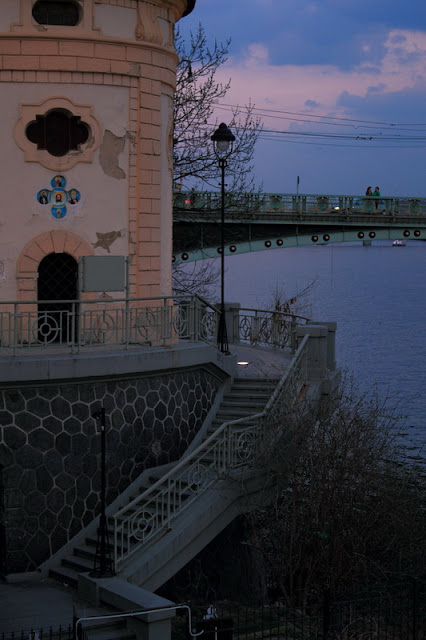
Hohenfels Volks: Sunset in Prague
ISO 400, f/5, 1/100, 44mm, daylight balanced. The shot was metered for the rotunda and exposed for M+1, then edited for M-1, increasing the saturation and improving the tonal range.
This was one of the sunset shots taken in Prague last weekend. It took several attempts to get it right, but just moving around made the scene match what I had envisioned. Give it a try for yourself before you shoot that next pic!

Take a walk around your subject. Approach from different angles and distances. You will start seeing how these little limitations can open up a whole world of possibility. The old masters had to work with 1 focal length or lens for a long time. Lenses were heavy, cumbersome, and often not the way to get the shot. Learning to see in this way is a great tool to open up your creativity and improve your composition.

Rise to the challenge and share your shots. We’d love to see your work and the fruits of your exercise. Enjoy the rest of a wonderful week and make sure you get 1 in the can!

Don’t forget to post any of your images you’d like to see here at the Hohenfels Volks Facebook page. Of course, commenting on both Facebook and here is always appreciated, too! Don't forget, we're on Google+, too!

Friday, March 30, 2012

Weekend Thoughts

Greetings, volks. Welcome to Hohenfels Volks, THE place for our place! The cold weather seems to put a damper on things, but if you’re tenacious, you’ll be able to drag home the shot that would have gotten away.

Today’s post is just a quick review of things going into the weekend, and a little psyching for Monday’s exercise. Remember your exposure triangle and the relationship between the sides, which will be the big factor for a lot of your shooting on the technical side. Also, remember to visualize and compose your shot. See the image before making it. Slow down and get it right before you release your shutter. Use your color to create some detail and interest, go so far as to make it your subject!

O.K. on to the psyching we go. Here are some things to learn, review, and acquire. Over the next few weeks, you’ll need a fixed focal length lens, AKA a prime. You’ll need a flash and some lighting modifiers. A 5 in 1 reflector, if you can’t or don’t want to get a flash. You’re also going to need a handy way to calculate your DOF and shoot accordingly.

Those are just a few things we’ll be working with. If you have them, break out your manuals, if not, get them! It will certainly provide some tools to make your photos the envy of all.

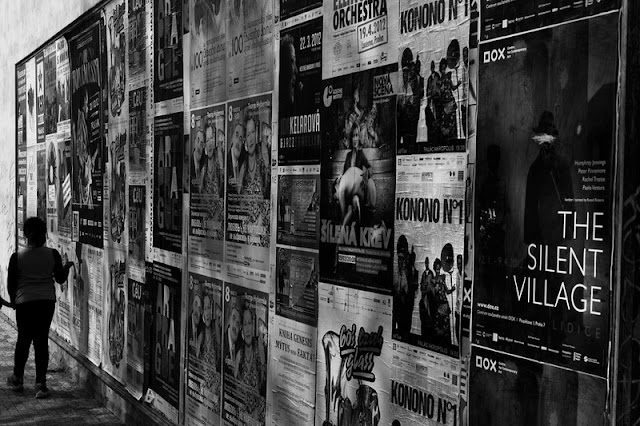
Hohenfels Volks: Wall with Posters
ISO 200, f/11, 1/50, taken with a green filter for contrast and detail.
Girl examining a wall plastered with posters in Prague. With the green filter, the contrast is just about right, and the red detail is dropped about 2 stops, increasing contrast in the red/blue and red/green areas. The higher contrast adds some isolation to the impression from the scene.

Well, that’s enough for now. Enjoy the weekend, have some great adventures, make some magnificent photos, and enjoy the life you have to its fullest!

Don’t forget to post any of your images you’d like to see here at the Hohenfels Volks Facebook page. Of course, commenting on both Facebook and here is always appreciated, too! Don't forget, we're on Google+, too!
Thursday, March 29, 2012

Announcing...

Greetings, volks. Welcome to Hohenfels Volks, THE place for our place! Welcome to another post.

With the wonderful weather and some time to relax, I haven’t done much posting lately. I apologize, but keeping up with family, work, and photography has kept me busy. I hope everyone has been enjoying the last week or so of great weather and the joy of spring! With the start of Spring and better weather, I know I’ll be out more with my cameras and family making some great shots.

Speaking of great shots, it’s time to talk about some ways we can improve our photography. One of the best ways we can improve is to learn to look, see, and use what we have to get the shot we visualized. To that end, we’re going to start a new weekly exercise here at Hohenfels Volks. Rather that going back to themes right now, I thought we’d try this to see how it works out.

The exercises may involve themes, but will revolve around techniques and learning by placing limitations or requirements for certain shots. Should anyone want to post your results, we’d be more than happy to accept and put them up here. Of course, your pics do not have to be related to themes or exercises to be put up, we’d love to see what you’re doing with your camera!

Here's a pic from Prague to get the juices going!

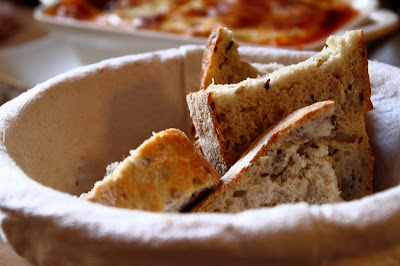
Hohenfels Volks: Bread Basket
ISO 800, f/5.6, 1/25, 55mm
The Bread Basket. Rustic rye break in a restaurant in Prague. Metered for the bread shadows, and stopped down 2 stops.

That’s about it for today. Tomorrow we’ll do something on limitations and expectations, leading into Monday’s exercise. I hope everyone will tune in and start to look for some great shots. Have a great evening and see you tomorrow!

Don’t forget to post any of your images you’d like to see here at the Hohenfels Volks Facebook page. Of course, commenting on both Facebook and here is always appreciated, too! Don't forget, we're on Google+, too!

Wednesday, March 21, 2012

Shot Records

Greetings, volks. Welcome to Hohenfels Volks, THE place for our place! The wonderful weather has given rise to many photographic opportunities; I hope you’ve taken advantage of it to create some art.

Today we’re going to discuss the importance if shot records. No… not a transcript of your vaccinations. We’re going to talk about recording information about your shots as a learning tool.


A sample shot record

In the above shot, you have fields for all the important information. If you remember in a previous post, we discussed the exposure formula. If you recall, your shutter speed should be the reciprocal of the luminance in foot-candles, at your key stop. Your key stop is the square root of your ISO, or the nearest stop to it. For ISO 100, it’s f/10, ISO 125 it’s f/11, ISO 400 it’s f/20 and so on. In the sample record, we see that shot 3 was ISO 125, metered at f/11. At our mid-tones, we metered 1/200, which means we have 200 foot-candles in the middle of the scale. Notice that trying to keep the middle values properly exposed, we changed to f/16 at 1/100, which gives us the same exposure, but more DOF.

By tracking your shots with something similar, you can keep track of what levels you want to record at the desired exposures and refer back to it once your images are on the computer. Another nice thing about it is the ability to recall where and when you took a shot.

By recording your meter readings, you know how to move your image areas to the desired exposure, according to your vision. In the same example, we see the shadows read 1/25 at f/11. That would expose for 18% gray, as we all know by now. By stopping down 2 stops, say to 1/100, we keep our texture in the shadow areas of the image, while allowing our gray to move up to 18% +1 stop, giving a brighter overall appearance to our image and creating a bit of glow about our middle values. This is especially true when they are surrounded by slightly darker tones, and an even, soft light.

The simple fact is that shot records help us learn, as we examine our images and review our settings, we see how to improve our exposures. We also see how to create better lighting and impact by changing values. I am often remiss in keeping records of my settings as I take the shot, but have a form that I use taken from Ansel Adams’s book, The Negative. It uses zones and luminance values, and includes details on development and the like.

As we move through the phases on our journey toward crafting and making the perfect photo, we can see where we’ve been, and where we’re headed if we keep records. In today’s digital age, EXIF gives us our ISO, f/stop, shutter speed, and other information. The things it can’t give us are our luminance values, meter readings for other than middle gray, and it certainly can’t tell us the real subject of the shot.

That’s enough for today. I hope everyone has the chance to work on crafting their images and creating their masterpiece! Just remember to record the details. Enjoy the rest of your week!

Don’t forget to post any of your images you’d like to see here at the Hohenfels Volks Facebook page. Of course, commenting on both Facebook and here is always appreciated, too! Don't forget, we're on Google+, too!

Wednesday, March 14, 2012

Motivation

Greetings, volks. Welcome to Hohenfels Volks, THE place for our place!

Today we’re taking a trip into the realm of motivation. This can have a big impact on your images and art. We’ll be short today, and give you some time to get the shot.

We’ve discussed inspiration, which, on the surface, seems to have some connection with motivation. But, motivation involves more than being inspired, it involves your mindset and desire. Many Volks out there often have no motivation to go out and make photos; they’re busy with life, which is understandable.

A great way to get motivated to make photos is to bring your camera everywhere. In my case, I usually have one with me, whether it’s film or digital. Taking your camera everywhere gets you into the habit of looking for that magic light, of looking beyond the surface. It brings a bit of the itchy shutter finger, and the desire to shoot something that inspires us.

Part of getting motivated is to incorporate photography into activities you’re doing or plan to do, anyway. A good example is taking a walk, going out to get fresh air or burn calories. By having your camera, you can kill 2 birds with that desire to get out. Maybe it’s playtime with your child or a day trip with the family. Plan in advance some things you’d like to see, and that you’re likely to want a shot of. Then when you’re out playing, walking, or day tripping, you can get your photos and still accomplish your primary task.

Getting motivated is much easier when you combine the basic functions you’re doing, anyway, with your photography.

Here’s hoping the rest of your week is great, and you’re motivated to make a winning image!

Don’t forget to post any of your images you’d like to see here at the Hohenfels Volks Facebook page. Of course, commenting on both Facebook and here is always appreciated, too! Don't forget, we're on Google+, too!