Monday, September 23, 2013

Improve Our Seeing

Greetings and welcome to Hohenfels Volks, THE place for our place! Hohenfels is getting ripe for photographic opportunities. Within the next couple weeks, the “autumnal fireworks” will really be in swing. Time to explore our areas and get your images made!

Today we’re going to provide a couple exercises to get you thinking about your photography and small ways to improve.

First up, we’re going to look at the use of tone and tonal variations to improve our shots. The exercise is simple enough. You’re going to need a couple lightly textured items to photograph. A couple differently colored towels or pillowcases will suffice. The object is to learn how our exposure impacts our tonal ranges, and how tones translate into an important element of our final image.

It’s best to use red, green, and blue items, but whatever you have at hand will work. Set up your item and meter it. In manual mode, set your exposure to give you –3 stops exposure and make a photo. Repeat for every full stop between –3 and +3 stops. You’ll have 7 photos. Do that for the other colors. Compare them in your image editing application, and see how the saturation, texture, and feel of each color changes with the different exposures and colors. Then take the same series of photos, but put your different items in the same frame. Finally, convert the last series to monochrome, and review one last time. After reviewing them all, you can see the difference in tones and moods. This is a big part of visualization, knowing how your camera’s rendition of color and light will present itself in the final image. It’s a simple exercise that does more than give you that knowledge; it also shows you what your camera can do. By knowing that there should be texture through all the shots, you can identify where your camera begins to lose that texture. Hey, since it’s autumn, you can combine the shots with more than all you colors into making something to hang on your wall by shooting something of the autumn around you.

Hohenfels Volks: Technicolor Pathways
ISO 100, f/15, 1/25
One of my older photos, taken just outside Hormansdorf. The track to the field was dappled and the tonal range of the colors brought to mind something from childhood, a reminder that God's beauty is everywhere. Notice how dark and light tones of the same color come into play here, creating contrast and enhancing the feeling of magic.

The next exercise is patterns. Learning to recognize patterns is something we all naturally do from an early age. But, patterns can be subtle or glaring. Stucco has a nice texture, and can have something of a pattern to it if you observe it long enough. Decorative tiles, clothing, and even bark will present something to create the feeling of a pattern if you open yourself to it.

The exercise is shooting 5-10 photos of patterns around you. This can be the tracks from a tractor in a just harvested field, the still tall rows of corn, your hounds-tooth pants, anything presenting a pattern. Corn on the cob present a nice pattern that can be presented and intensified by including the green of the husk and the golden caramel brown of the outer silk. They’re everywhere once you open up to them! It’s a great way to add interest to your photography, and bring you into a closer relationship with the scenes we take for granted every day. There is so much in God’s green Earth to see and feel, that an entire lifetime isn’t enough to experience it all!

I hope everyone will get out and make some photos, both for the exercises and to celebrate autumn’s beauty. There’s no time like now to get shooting! Figure out where and when, the rest will follow. Then, make your shot and share it with us on our Hohenfels Volks Facebook page. We’d love to see your work.

Is there anything you’d like to see here? Do you have a question? Share your thoughts here or at the Hohenfels Volks Facebook page. Of course, commenting on both Facebook and here is always appreciated, too! Don't forget, we're on Google+, too!

Tuesday, September 17, 2013

Autumn Care

Greetings and welcome to Hohenfels Volks, THE place for our place! Here in Hohenfels, the Sun made a couple cameo appearances but wasn’t able to stir up any kind of significant warmth. The rain put a damper on the spirits, as did the fact that it’s a workday!

With autumn’s brutally chilled arrival, we’re nearing the time to shoot some real color! There’s always some excitement about the colors, shapes, textures, and patterns that accompany autumnal photography. As I mentioned in yesterday’s quote, now’s a great time to think about negative space and the use of color to create tension, balance, and harmony in your photos, and bring about the connection you’d like to make.

Hohenfels Volks: Black Velvet, flowers in Bayreuth
ISO 800, f/11, 1/60
These flowers were shot at the Hermitage in Bayreuth. A Wratten #8, yellow, filter was used. By using the filter, the green was brought up slightly, and the white flowers separated from both the red flowers and green leaves. By allowing a rich grey-black to fall on the leaves and red flowers, a velvety feeling of negative space results. While fragmented and carrying visual detail, it is by no means the subject, and yet becomes a subject of its own.

Along with the march of color into the dreariness ahead, comes other factors that photographers should take note of. First, is the rapid decrease in temperatures, the drop in temperature can take the starch out of an exciting day. Another factor is the rain, always something to be ready for in our Hohenfels area. Getting your camera wet can lead to issues that no one wants!

One of the biggies, I’ve found, is the increase in static. For the most part, photographers don’t have to worry about while photographing with digital cameras. It’s when the time comes to change cards or clean your sensor, or even change your lens that it becomes an issue. A typical “zap” can have as much as 30,000 volts jumping from one surface to another. Enough to ruin your day if it arcs over onto your sensor. Since most folks don’t clean their sensors beyond a squirt from a bulb blower, it’s pretty reasonable to say that the standard precautions are sufficient.

With film, though, static can be a big problem. Advancing film, rewinding film, activating the shutter, removing a dark slide, all these things can cause an arc that will ruin your shot. The can also damage your shutter curtains if your camera uses cloth. In the driest and coldest weather, it could damage your sensor, but that’s unlikely.

The biggest threat to digital cameras during this time of year is the condensation from thermal transitions. That’s a fancy way of saying going inside from outside. I’ve found one of the best ways to protect anything is a Ziploc bag and 30 minutes. Don’t plug your camera in, put your card in your reader, or power on your camera when you first come in. The temperature change can cause moisture, which we all know, doesn’t sit well with electronics! Think about glasses fogging over when you come in from the cold!

Another awesome tip- when you get in from the cold, make a big cup of hot cocoa, with extra chocolate. It’ll warm you up, and give time for your gear to reach a suitable temperature! It helps if you have someone to share it with. A nice cup of cocoa with my little princess makes for some fun talk time, and 30 minutes is gone before you know it!

Now’s the time get scouting and planning your autumn shots. Figure out where and when, the rest will follow. Then, make your shot and share it with us on our Hohenfels Volks Facebook page. We’d love to see your work.

Is there anything you’d like to see here? Do you have a question? Share your thoughts here or at the Hohenfels Volks Facebook page. Of course, commenting on both Facebook and here is always appreciated, too! Don't forget, Hohenfels Volks is on Google+, too!

Wednesday, September 11, 2013

A Tryst

Greetings and welcome to Hohenfels Volks, THE place for our place! Another rainy reminder that autumn is upon us. The colors and clarity of the season provide so much to intoxicate the spirit, and numb the body for the long cold ahead! Here, in Hohenfels, it’s no different!

It has been said that art is a tryst, for in the joy of it maker and beholder meet.
Kojiro Tomita

Again, another taste of the artistic and spiritual side. Kojiro Tomita was an early 20th century art expert from Japan. He had come to America to expose the U.S. to Japanese aesthetics and art. He was curator of the Museum of Fine Art in Boston.

I chose to use this particular quote to express what our photography can do, and how we involve our audience in our work.

When we feel our shot is the right one, when we see the scene, and visualize our final image, we often feel something beyond our technical and expressive processes. If we stop and think about what we’re expressing, and who we’re expressing it to, we begin to see a relationship take shape.

Neither party may know each other; indeed, they may be separated by centuries. At the same time, though, we are brought together for a small moment, in some connection that shares our feelings and viewpoints with those of our viewer. We connect.

Just something to think about the next time your out. If you’re out to make a portrait, find a way to include your subject, as well as your audience and yourself, in that connection. You’ll find a photo that will touch lives for generations to come! When making a still life, try to visualize the final product, and put yourself in the shoes of the viewer. How does that visualization make you feel? If your reaction brings you deeper into the scene, then your audience will no longer be your audience; they’ll be a tryst you enjoyed while expressing your vision, and enjoying your creativity! Of course, that’s just my thought!


ISO 3200, f/5, 1/30
Flowers in Vase, my tryst. This was taken in a little Vietnamese restaurant in Bayreuth during my last day trip. I made the shot knowing that the flowers in stark isolation against the background would create a sense of isolation, especially with all the negative space. I also noticed, even in that sea of isolation, that the flowers were not alone. Their isolation created a balance that allowed their relationship to transcend appearances and become tryst like in its relation of tones, shapes, and placement. I knew this one would speak to someone as a reminder that we are never alone, even when we feel like it. To paraphrase Ansel Adams, "There are always two people in every photo." That seems to go along with today's theme nicely.

I hope all our Hohenfels Volks readers will get out and create something of a tryst in their photography, and share it with us on our Hohenfels Volks Faceboook page. We’d love to see your work.

Is there anything you’d like to see here? Do you have a question? Share your thoughts here or at the Hohenfels Volks Facebook page. Of course, commenting on both Facebook and here is always appreciated, too! Don't forget, we're on Google+, too!

Monday, September 9, 2013

Presence

Greetings and welcome to Hohenfels Volks, THE place for our place! Rain, sun, wind, chills, and warmth. All the seasons were experienced in one day here in Hohenfels!

Be still with yourself until the object of your attention affirms your presence.
Minor White

It's amazing the insight in that little quote...

Communication exists between the photographer, the subject, and the viewer, and can only be understood by those few who feel the affirmation of the object upon which you've cast your attention.

I posted that earlier today on our Hohenfels Volks Facebook page. It’s meant to call attention to the fact that our expressions have a link to the subject.

Many of the early and famous photographers were quoted saying things about the importance of creativity. They were also famously quoted speaking or writing about expression and the relation of photography to communication. Ansel Adams said there are always 2 people in a photograph, even one devoid of people, the photographer, and the viewer.

It’s important to remember that even though we see no person when we make the image, we are indeed communicating our feelings, thoughts, and ideas about the subject to our future viewers. We are also expressing something of our feelings and thoughts about our potential viewers. When we think of our viewers, and what we hope for them to feel and opine on our images, we are indeed receiving their affirmation. If our viewers are not an object of our attention, then what else is? Beyond our subject and ourselves, there is little left to affirm our presence.

Of course, our subject affirming our presence may seem ridiculous, as often we photograph the inanimate. This affirmation can be almost spiritual, it’s an awareness of the light, the shade, the texture, and the myriad other things that make our expressions our own, and help us communicate across all boundaries. We generally feel this affirmation as what Cartier-Breson called the “decisive moment.”

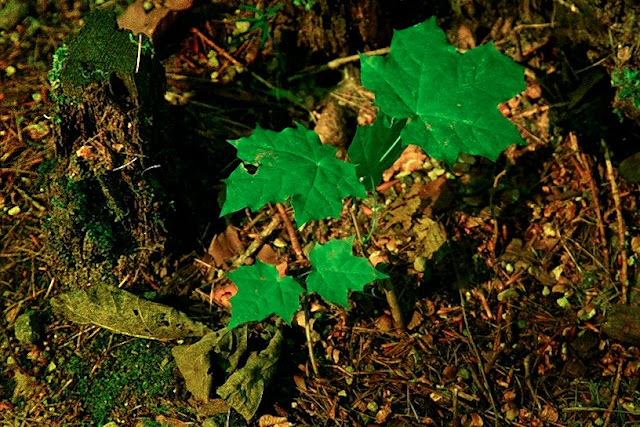
Hohenfels Volks: Rebirth In Bayreuth
ISO 1600, f/8, 1/30
Another angle on yesterday's photo. I love the way the green leaves stand out both visually, and metaphorically, against the orange, and even above the greens of the moss. By creating a connection with the scene, I was able to express my love of the way new lives grow from the old, and yet remain part of the old.

I hope everyone gets the chance to seek the their object's affirmation, and will feel their images. I also hope you’ll share them with us on our Hohenfels Volks Facebook page. We’d love to see your work.

Is there anything you’d like to see here? Do you have a question? Share your thoughts here or at the Hohenfels Volks Facebook page. Of course, commenting on both Facebook and here is always appreciated, too! Don't forget, we're on Google+, too!

Sunday, September 8, 2013

Jaunty in Hohenfels

Greetings and welcome to Hohenfels Volks, THE place for our place! Several days of beautiful weather have made life comfortable here in Hohenfels and our surrounding areas. Bayreuth last weekend was especially beautiful, as the clouds and lighting made for some magnificent wooded shots. Yesterday’s clear skies made the Nuremberg flea market, scattered throughout the old parts of town, a place full of photographic treasures.

Today’s post is short and simple. We’re going to talk about day jaunts to local areas. We’re not going to expound too much on places, it’s more about finding and making photos we like. Expressive images make the creative process a reward in itself, and being prepared can make a big difference.

I’m planning a mid-Autumn trip to Bayreuth to make some photos. The intent is to make some beautiful photographs of the autumn state at a couple places there. The first one is the Hermitage. I fell in love with this place on my first visit. The lighting, textures, and wooded areas make for something magical. The second one is at the New Residenz, which is similar, but has a completely different feel. I also hope to make a portrait or 2, and shoot some slide film.

The reason I mention that, is our main reason for the topic today. When we make our jaunts and trips, it’s always a good idea to know what to expect. By making a trip or 2 in advance, and maybe some shots of our ideas, we can be prepared for the situations we’re likely to encounter. For instance, at the Hermitage a reflector is a good idea. On a sunny day, it can be used to fill in the shaded areas with light streaming through the trees. Because of the large volume of trees, autumn will increase the warmth of the light, and a clear day will help keep it from going to warm. In Regensburg, I might rely on a golden reflector or gelled flash, as the light in the park by the bahnhof feels quite different. In either place, flash and gels are vital to getting a portrait to be more in line with our vision and intent.

Around our area, going place to place is simply a matter of taking the train. A train to Bamberg doesn’t take too long, and can lead to some quiet contemplation of what our intentions may be. We can also relax on the way back and reflect on our efforts. Trains also provide an easy way to scout a location. They run close to our own schedules in most cases, and we can leave when we see fit, or stay as long as we want. Avoiding the traffic allows for more insightful planning and reflection.

Hohenfels Volks: Rebirth In Bayreuth
ISO 1600, f/8, 1/30
Rebirth in Bayreuth. Green against orange. Leaves intensified by shooting with a yellow filter. Yes, black and white filters can be used on digital cameras. By bringing out the green slightly, the leaves are made to stand out. Just a small fraction of the beauty in Bayreuth. The leaves growing from amidst the decay of an older tree brought a sense of rebirth, and second chances, the shallow DOF allows a more meaningful contemplation. I plan to re-do this shot when the leaves are changing for a different mood.

On another note, I’m hoping we can get some volks to contribute a small article about a place they like to shoot, and maybe some pics. It’ll help flesh out our “Your Works” and “Our Places” pages, and help others out with their day trips.

I hope all of you will get out and plan a day trip to make some shots. I also hope you’ll share it with us on our Hohenfels Volks Faceboook page. We’d love to see your work.

Is there anything you’d like to see here? Do you have a question? Share your thoughts here or at the Hohenfels Volks Facebook page. Of course, commenting on both Facebook and here is always appreciated, too! Don't forget, we're on Google+, too!