Monday, September 9, 2013

Presence

Greetings and welcome to Hohenfels Volks, THE place for our place! Rain, sun, wind, chills, and warmth. All the seasons were experienced in one day here in Hohenfels!

Be still with yourself until the object of your attention affirms your presence.
Minor White

It's amazing the insight in that little quote...

Communication exists between the photographer, the subject, and the viewer, and can only be understood by those few who feel the affirmation of the object upon which you've cast your attention.

I posted that earlier today on our Hohenfels Volks Facebook page. It’s meant to call attention to the fact that our expressions have a link to the subject.

Many of the early and famous photographers were quoted saying things about the importance of creativity. They were also famously quoted speaking or writing about expression and the relation of photography to communication. Ansel Adams said there are always 2 people in a photograph, even one devoid of people, the photographer, and the viewer.

It’s important to remember that even though we see no person when we make the image, we are indeed communicating our feelings, thoughts, and ideas about the subject to our future viewers. We are also expressing something of our feelings and thoughts about our potential viewers. When we think of our viewers, and what we hope for them to feel and opine on our images, we are indeed receiving their affirmation. If our viewers are not an object of our attention, then what else is? Beyond our subject and ourselves, there is little left to affirm our presence.

Of course, our subject affirming our presence may seem ridiculous, as often we photograph the inanimate. This affirmation can be almost spiritual, it’s an awareness of the light, the shade, the texture, and the myriad other things that make our expressions our own, and help us communicate across all boundaries. We generally feel this affirmation as what Cartier-Breson called the “decisive moment.”

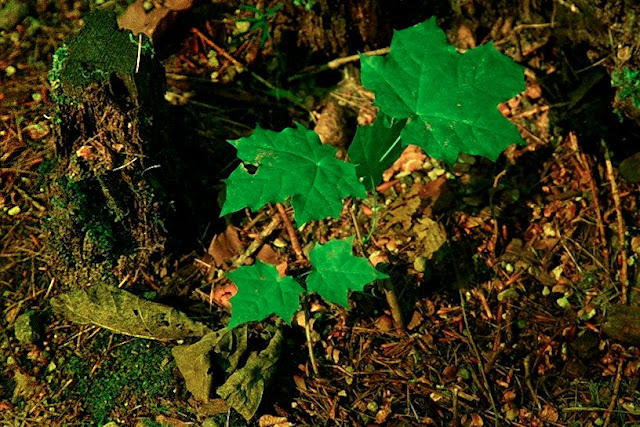
Hohenfels Volks: Rebirth In Bayreuth
ISO 1600, f/8, 1/30
Another angle on yesterday's photo. I love the way the green leaves stand out both visually, and metaphorically, against the orange, and even above the greens of the moss. By creating a connection with the scene, I was able to express my love of the way new lives grow from the old, and yet remain part of the old.

I hope everyone gets the chance to seek the their object's affirmation, and will feel their images. I also hope you’ll share them with us on our Hohenfels Volks Facebook page. We’d love to see your work.

Is there anything you’d like to see here? Do you have a question? Share your thoughts here or at the Hohenfels Volks Facebook page. Of course, commenting on both Facebook and here is always appreciated, too! Don't forget, we're on Google+, too!

Sunday, September 8, 2013

Jaunty in Hohenfels

Greetings and welcome to Hohenfels Volks, THE place for our place! Several days of beautiful weather have made life comfortable here in Hohenfels and our surrounding areas. Bayreuth last weekend was especially beautiful, as the clouds and lighting made for some magnificent wooded shots. Yesterday’s clear skies made the Nuremberg flea market, scattered throughout the old parts of town, a place full of photographic treasures.

Today’s post is short and simple. We’re going to talk about day jaunts to local areas. We’re not going to expound too much on places, it’s more about finding and making photos we like. Expressive images make the creative process a reward in itself, and being prepared can make a big difference.

I’m planning a mid-Autumn trip to Bayreuth to make some photos. The intent is to make some beautiful photographs of the autumn state at a couple places there. The first one is the Hermitage. I fell in love with this place on my first visit. The lighting, textures, and wooded areas make for something magical. The second one is at the New Residenz, which is similar, but has a completely different feel. I also hope to make a portrait or 2, and shoot some slide film.

The reason I mention that, is our main reason for the topic today. When we make our jaunts and trips, it’s always a good idea to know what to expect. By making a trip or 2 in advance, and maybe some shots of our ideas, we can be prepared for the situations we’re likely to encounter. For instance, at the Hermitage a reflector is a good idea. On a sunny day, it can be used to fill in the shaded areas with light streaming through the trees. Because of the large volume of trees, autumn will increase the warmth of the light, and a clear day will help keep it from going to warm. In Regensburg, I might rely on a golden reflector or gelled flash, as the light in the park by the bahnhof feels quite different. In either place, flash and gels are vital to getting a portrait to be more in line with our vision and intent.

Around our area, going place to place is simply a matter of taking the train. A train to Bamberg doesn’t take too long, and can lead to some quiet contemplation of what our intentions may be. We can also relax on the way back and reflect on our efforts. Trains also provide an easy way to scout a location. They run close to our own schedules in most cases, and we can leave when we see fit, or stay as long as we want. Avoiding the traffic allows for more insightful planning and reflection.

Hohenfels Volks: Rebirth In Bayreuth
ISO 1600, f/8, 1/30
Rebirth in Bayreuth. Green against orange. Leaves intensified by shooting with a yellow filter. Yes, black and white filters can be used on digital cameras. By bringing out the green slightly, the leaves are made to stand out. Just a small fraction of the beauty in Bayreuth. The leaves growing from amidst the decay of an older tree brought a sense of rebirth, and second chances, the shallow DOF allows a more meaningful contemplation. I plan to re-do this shot when the leaves are changing for a different mood.

On another note, I’m hoping we can get some volks to contribute a small article about a place they like to shoot, and maybe some pics. It’ll help flesh out our “Your Works” and “Our Places” pages, and help others out with their day trips.

I hope all of you will get out and plan a day trip to make some shots. I also hope you’ll share it with us on our Hohenfels Volks Faceboook page. We’d love to see your work.

Is there anything you’d like to see here? Do you have a question? Share your thoughts here or at the Hohenfels Volks Facebook page. Of course, commenting on both Facebook and here is always appreciated, too! Don't forget, we're on Google+, too!
Tuesday, August 20, 2013

The Color Crutch

Greetings and welcome to Hohenfels Volks, THE place for our place! WOW… seven months have past since our last post. Things have been quite busy, photographically and otherwise. Things have been too good to pass up, the weather has been quite amazing, and opportunities to make some photos have abounded.

Today’s post is a quick comment on what I’ve dubbed “the color crutch.” We’ve come to think of color as something that makes the image, that more and more saturation is the way to go to express our intended mood. It’s incredibly noticeable in HDR images, where everything is pushed beyond the need of the scene and intent.

A well-made image carries its intent through many elements, and sometimes the absence of elements can improve an image. Yet, somehow, we’ve adopted a bold color=bold image mentality. All too often it doesn’t, it just equals a garish rendition of an otherwise pleasing image.

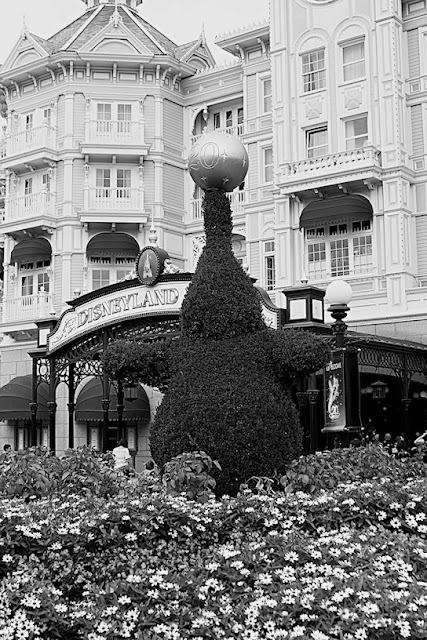
Moods, even joy, can be carried without color. The elements of composition, the light, the shadows, the contrast, and the subject matter can make even something plain into something buoyant when combined for the expressive image. An image that matches our intent and expresses a mood or feeling, with or without color, is a thing of beauty. The following image shows how color can be removed, and the mood amplified. While not one of the greats, it's a fitting example.

Hohenfels Volks: Shrub Sculture Disney Paris
ISO 200, f/8, 1/125
Shrub sculpture near the entrance to Paris Disneyland.

This was shot in color on the 7D, colors were set in the channel mixer to match Kodak’s discontinued Plus-X film, the image was then converted to a negative, and the curves for Plus-X were applied via a Curves adjustment layer. The final step was adjusting levels to match the proper range that would be printed. The final image is light and expresses much of the joy that a visit to Disneyland instills, even in us old kids.

The use of light can carry much more of your expression and intent in most cases, than just over-doing the saturation. Overdone saturation, if that is your original intent and vision, is your expression. No one is saying it has no place. Color can amplify mood, it can create triggers within anyone, many linked by our common experiences. The issue arises when it’s done for no other reason than the thought that a weak image will be good if we amp it up. Photography is an art, and every individual uses their experiences, desires, and feelings to create something magic. Don’t let color be a crutch that hinders your magic, but don’t be afraid to use it, either!

I hope that everyone will manage to make their expressive shot, color or monochrome, and share it with us on our Hohenfels Volks Faceboook page.

Is there anything you’d like to see here? Do you have a question? Share your thoughts here or at the Hohenfels Volks Facebook page. Of course, commenting on both Facebook and here is always appreciated, too! Don't forget, we're on Google+, too!
Thursday, January 17, 2013

Cheat...

Greetings and welcome to Hohenfels Volks, THE place for our place! Wow, a long has passed since our last post! Hohenfels has been in the grip of a dark and dreary winter. The warmth of the holidays and time with loved ones speeds the passing of winter, although not nearly enough.

Today we’re going to discuss the possibilities of making a quick cheat sheet for our camera bag.

Our cheat sheet won’t have everything to make us better photographers, that’s the job of the individual, but it will make a handy reference for quick calculations in the field. We’re just sharing some common knowledge and quick facts to tuck away for when you’re out shooting.

The first thing to remember is the “Sunny 16” rule. This simply states that in full sunlight, on a clear bright day, with an average brightness, set your aperture to f/16, and your shutter speed to 1/film speed. You’ll almost nail most of the time. For instance, at ISO 100, shooting at f/16, you should be shooting at 1/100 second.

This can be extrapolated to the following combinations, based on lighting:
f/11 at 1/ISO for hazy sunlight with soft shadows,
f/8 at 1/ISO for cloudy bright conditions, without shadows and an obscure sun, and
f/5.6 at 1/ISO for dull and cloudy, dark skies and no sun.

These values pertain to daytime shooting only, and will get you in the right place for most situations. If you’re shooting in open shade, open your aperture 2-4 stops, depending on your subject brightness. This may mean shooting at slower speeds, so keep that in mind.

Another useful bit for you deals with motion. First, subjects at a distance will allow slower speeds. Second, direction of motion and speed of motion are important factors in shutter speed, as well. A subject moving directly toward or away from the camera allows a slower shutter speed. With a direction of motion at 45 degrees to the camera, you will usually shoot at double the head on speed, and at 90 degrees direction, at 4 times quicker.

For subjects moving directly toward or away, shutter speeds of up 1/25 allow for good images, at speeds of 5-10 MPH and distances at 100 feet or more. The same subject at 25 feet, doing 60 MPH at 25 feet requires 1/400 or faster. At 90 degrees, 100 feet, doing 5 MPH requires 1/400 shutter. Keep these in mind when out shooting action or motion, and you can generally get better shots.

Of course, the above information is in no way complete, or 100% accurate, but it does provide some general guidelines. Keep these couple tidbits in mind, and you can dial in your exposure manually and get the levels, and therefore, the image, you desire. Little bits of knowledge add up, and when put together, can make you one of the photographers who can make your shots match your vision.

I hope that everyone will try to out together their own cheat sheet, make the shot, and share it with us on our Hohenfels Volks Faceboook page.

Is there anything you’d like to see here? Do you have a question? Share your thoughts here or at the Hohenfels Volks Facebook page. Of course, commenting on both Facebook and here is always appreciated, too! Don't forget, we're on Google+, too!

Thursday, December 6, 2012

10,000 Revisited

Greetings, volks. Welcome to Hohenfels Volks, THE place for our place! Everywhere you look, you’ll see white! Winter is here for the long haul, and that means it’s time to get some seasonal shots. I hope everyone is getting geared up for Christmas and some great photography.

Earlier today, we had blue skies and some nice clouds, perfect for the landscape shooter in all of us. Of course, things turned ugly quick, and left us in the midst of a dark and icy wall of snow. As often happens, the sun managed to beat back the snow and again we were ready for making some great shots.

Enough weather, that’s not what we’re here for, right? Today we’re going to talk about pride and accomplishment. It’s also a chance for an exercise in good old-fashioned photography. Even though we’re using our digital cameras, and often forget the importance of each shot we make, we can return to the old ways. Remember, as Henri Cartier-Bresson said, “You’re first ten thousand shots are your worst.” In a much older post, we addressed this and modified it to be about 100,000 to 1,000,000 shots. This is due to the inherent nature of instantaneous feedback and automatic cameras.

In the earliest days of photography, folks used glass plates for their negatives. Then film came along. In those early days, your film, or plate, was only sensitive to blue light. This made balancing your light and color very important. With the advent of thinner films and panchromatic emulsions, more sensitivity was added. Then, of course, came color film. When you shot either a sheet or roll, you couldn’t change your ISO or color balance. Film and digital sensors can be thought of as the same thing, and for the rest of this article will be used interchangeably.

Film costs money. It cost money in the old days, as well. When a photographer made shots, he weighed the value of the film and the shot. Every photograph was precious, and had to be made with care. Exposure, color balance, even composition had to be weighed and given some measure of value in relation to the photo. Photography took time, to both master, and in terms of the individual image created. Light meters for measuring exposure, going back to the 1800’s, are available on auction sites all over the internet. Focusing aids, powder flashes, apertures, and even shutters were part of the photographer’s knowledge. In many of the older lenses, the aperture was adjusted using an insert placed in the lens at the time of the photo.

Now that we see how valuable the image was, and the knowledge to make an image, we can see how those early photos, and those that have come down to us through the years, were not the product of guesswork or automation.

For the next few days, try doing an exercise in film. Choose one ISO for your camera, choose one color balance, and only limit yourself to 36 shots per session. Remember, getting your color balance and ISO right will require thought and planning. It will also require learning about your intended shooting situation. If you’re shooting outside, shoot in daylight or around 5200K, and inside shoot at tungsten or around 3200K. If you’re shooting in bright conditions, choose ISO 100, in the dark ISO 800. Finish your 36 shots before changing your settings. Also, don’t look at your images on the camera monitor, or delete any shot. Wait until you get home to see what you have. This will encourage you to value your images, while also helping you improve.

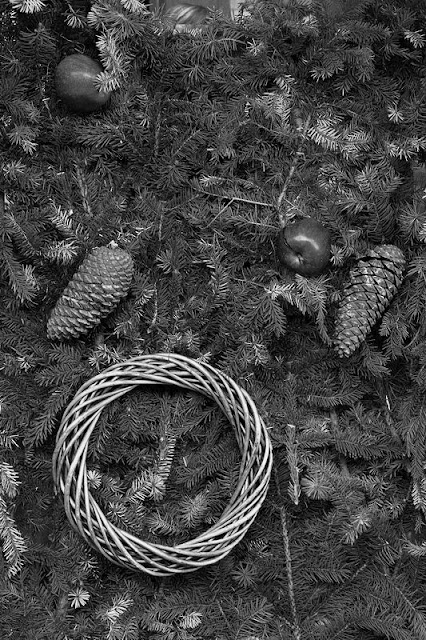
Hohenfels Volks: Dresden Christmas
EI 500, f/5.6, 1/60, 56mm
I couldn't resist this shot, the mix of shapes, textures, and tones are intriguing! Shooting manual all day, let me have control of the camera, instead of the camera controlling me. It also allowed me to use my knowledge to get what I wanted.

This little exercise will require you to know your camera settings, it will require the knowledge to get the shot right, and it will allow for a sense of visualization to settle in. Visualizing your image is an incredibly useful tool in photography. This is a great time to undertake this exercise, as our changing weather conditions, and lighting, will challenge even the best without proving impossible with a little effort. As an added bonus, it’ll make every shoot an adventure, and every moment until the photos are loaded like Christmas. It’s a fun way to experience the anticipation of Christmas with a gift in every session! It’ll also make shorter work of getting the best shots, since you’ll be improving with each photo made. You’ll also develop your confidence, which always helps! Remember, a great camera doesn’t make a great photographer, any more than a great kitchen makes a great cook.

Please feel free to share your photos on our Facebook page. Everyone here would love the chance to see your work! Is there anything you’d like to see here? Do you have a question or an idea? Share your thoughts here or at the Hohenfels Volks Facebook page. Of course, commenting on both Facebook and here is always appreciated, too! Don't forget, we're on Google+, too!