Greetings, volks. Welcome to Hohenfels Volks, THE place for our place! Old Man Winter is settling in for his long stay here in Hohenfels! I hope everyone is settling into their anticipation and excitement for the long nights and brilliant moments ahead.
It’s certainly been some time since my last post! I’ve been quite busy as usual. Branching out into large format photography has filled me with new ideas and visions. I hope to make some of the winter shots I’ve been visualizing and preparing for. Large format gives you a way of relating to the scene and subject that it’s hard to imagine without seeing it. This leads us to today’s basic topic, shooting tethered.
One distinct advantage of the digital age is the ability to hook up to a computer and see our images presented quite large. When we load our photos onto our PCs, it gives a way to see detail an ordinary 4x6 print denies us. It also gives us a tool to learn far more rapidly, by allowing us to honestly assess our images in all their glory, and with all their flaws.
But, as many folks don’t know, it also gives us a way to see those flaws prior to making our shot. It allows us to compose our scenes at a scale which invites a more involved relationship with the image. It allows us to troubleshoot our images prior to recording them, and to resolve any images that may prevent the full realization of our vision.
Previously, this has been the domain of those with large format cameras, like the 8x10 field camera or a 4x5 view camera. The composition was done on a negative sized piece of ground glass, with the image upside down and inverted. This naturally led to a slower pace and more contemplative image creation process. Combined with film costs, equipment costs, and time costs, large format photography was largely practiced by those making money from it. With the proliferation of digital cameras and the advent of sites like E-bay, large format become reasonably priced to anyone with the desire and motivation to learn the ins and outs. The format can be daunting and challenging, sometimes extremely so, but it can also be rewarding.
Now that we have DSLRs capable of producing extremely high quality images, and the capabilities of our computers, we can all practice Large Format.
Now that the background is behind us, the steps and equipment are quite simple. You most likely have the equipment you need, as it probably came with your camera. This would include a USB cable to connect to your computer, and the capture software that allows for control of your camera. If your camera didn’t come with the capture software, your manufacturer may have it at their website. If not, there are commercial options available that run from free to higher priced options. You’ll want a tripod and maybe a platform for your PC if you want to use a laptop from other that your desk. That’s it. Just start the software, and for Canon’s, select Remote Live View.
Once you’re connected, you can control everything. You can focus in the autofocus mode using the software, or in manual mode. Both ways give you a giant magnification and full control of your focus. You can control white balance and display your camera’s metering, which will allow you to control your exposure and place your values below, at, or above, neutral gray. It allows for full functionality of the camera, and can even capture directly to your hard drive. The beauty is in a few Windows hot key shortcuts, you can zoom in the live preview, making your preview as large as your monitor. How’s that for large format? Focus, DOF preview, and exposure controls as if shooting directly form the camera, and viewing from the computer, it can’t be beat. You’ll know if you have a keeper even before making the shot.
This has been around some time, just search for tethered shooting, but the first thing to learn is exposure, white balance, and how to use your camera. Once you know these things, you can move on, in ways I can’t even begin to touch upon here! Using tethered shooting will give you an appreciation for all the detail in the scene and lead to a new found way of looking at the smaller parts of a scene to see the big picture. It also saves the frustration of having to sort through the good and the bad. You’ll find yourself making fewer bad images when you shoot tethered.
It has its drawbacks. Who wants to carry a tripod, computer, and cables everywhere? Who feels like lugging extra stuff to make the picture? There are trade-offs in it, but you’ll find if you’re shooting something for your own vision, or if your doing something where there is time to set up and work that way, tethered may be your new default!
I hope this gives you some new ideas. Getting out there and shooting , tethered or un-tethered, will give you the winning shot this winter, so get started making your images now!
Please feel free to share your photos on our Faceboook page. Everyone here would love the chance to see your work! Is there anything you’d like to see here? Do you have a question? Share your thoughts here or at the Hohenfels Volks Facebook page. Of course, commenting on both Facebook and here is always appreciated, too! Don't forget, we're on Google+, too!

Tuesday, December 4, 2012

Monday, November 12, 2012
Overlooking
Greetings and welcome to Hohenfels Volks, THE place for our place! After a rather gloomy week, punctuated with brief moments of beautiful clarity, we begin another week here, as bland as things have been recently! Hohenfels is turning toward the bleakness of winter, and as we end our autumn, we begin to notice the beauty hidden within the warm grasp of summer’s embrace.
Today we’re going to talk about how we often overlook things, objects, subjects, and other items that could be of interest to an observant photographer.
Humans, being creatures of habit, routine, and ritual, go through life overlooking things they encounter on a daily basis. We take notice only when something is new or suddenly gone. I’ve done this myself, and wound up losing a few shots. Taking anything for granted leaves us a little less than we could be!
Taking notice though, can make for the opportunity of a photographic lifetime! Everyday, during my drives through our wonderful Hohenfels area, I have driven past an area with some ledges and trees alongside the road. This autumn, some Aspen trees along this way turned the most brilliant yellow and orange-gold. They made the change before the rest of the leaves, and held on for so long! With trucks and buses racing by, bringing with them the icy wind clawing on the leaves, trying to pull them down, they have managed to cling for so long, apparently by sheer force of will! The scene was a bit of a “found object” as Ansel Adams called it, and yet everyday I passed it, seeing but not stopping. Today I took the chance, and standing alongside the road, made a couple shots. The negatives developed up nicely, and have some detail that makes me wonder how I ever passed the scene up. Tomorrow, God willing, I’ll make some digital photos, as the scene is too magnificent to pass up!
We begin to take for granted these scenes, and when they depart, we’re left feeling a loss. Of course, there will be next time, if things hold true. But, the disappointment lasts for some time. When we start to pay attention to the world around us, we start to see shots everywhere, there is no shortage of things to make images of. Take the time to stop and observe what’s changed in your area, make a note if you don’t have your camera, and come back to make the shot. You’ll usually be glad you did, and might even make some great memories in the process.
Well, enough preaching! I hope that everyone will see something new in the old, make the shot, and share it with us on our Hohenfels Volks Faceboook page.
Is there anything you’d like to see here? Do you have a question? Share your thoughts here or at the Hohenfels Volks Facebook page. Of course, commenting on both Facebook and here is always appreciated, too! Don't forget, we're on Google+, too!
Thursday, November 8, 2012
Plans...
Greetings and welcome to Hohenfels Volks, THE place for our place! Thursday in Hohenfels, that means it’s time to plan some weekend shooting!
Let’s start with a quote from Ansel Adams. He said, "I never know in advance what I will photograph... I go out into the world and hope I will come across something that imperatively interests me. I am addicted to the found object.”
Planning your shots doesn’t always mean going out with the intention of only shooting 1 thing. Planning your shots means going out with a plan and intention, then being fluid enough to take the shot you find. Part of planning your shot definitely is definitely visualizing the final image, but it doesn’t have to be done when you wake up!
Planning some shots for your autumn collection means planning to get some leaves, using the texture, color, and shapes to emphasize certain things. However, you may come across something that would make for a special “only available now” shot, and if you’re too intent on getting your planned shot, you may miss an opportunity.
In my case, it’s not too terribly hard to get distracted with a new shot or angle, even though I’ve planned everything. The light falling onto and emphasizing a certain part of the scene, a break in the clouds, or even something brought in on a breeze can make for some unplanned magic. As long as you’re open to the experience, and visualize your final image, you’ll make something to crow about!
Well, enough preaching! I hope that everyone will feel some pride in their vision and work, and share it with us on our Hohenfels Volks Faceboook page.
Is there anything you’d like to see here? Do you have a question? Share your thoughts here or at the Hohenfels Volks Facebook page. Of course, commenting on both Facebook and here is always appreciated, too! Don't forget, we're on Google+, too!
Tuesday, November 6, 2012
Creative Metering and Exposure
Greetings and welcome to Hohenfels Volks, THE place for our place! I hope everyone is getting a decent start to the week. The Hohenfels area is beautiful this time of year, as many of you know, and full of go-to places for some great shots.
Today we’re going back a little to some basics. We’re primarily going to look at metering and exposure.
We all know the basics by now, that your meter offers a combination to make the measured area fall at 18% reflectance, or neutral gray. Most of us know that by overriding that proffered setting we can take fuller control and get closer to our vision.
I’ve discussed metering and key stops before, but today we’re going to see how it can be used for maximum impact when combined with our vision.
I’ll be referring to the following photo as an example.

ISO 125, f/22, 1/2 on Ilford FP4+
I, Un-Subjugated.When we leave the I, or in this case the red, unsubjugated, a wider variety can thrive.
In the above image, both the highlights and shadows were extremely close in values, and were identical with the light shifting as it was. My initial reading was 15 c/f2 for the shadows and 30 for the highlights. The brighter leaves are red and the darker ones are green. Knowing the values were so close, with the red reading about 2/3 to a whole stop brighter, I chose a red filter to bring up the reds and decrease the greens. A red filter allows about 97% of the red light through, while only allowing about 12.5% of the blue and green. It also gives a factor of 8x or 3 stops. Throwing in the aperture decrease, I was shooting with 5 stops less available light for the greens and shadows. By adding 4 stops to their initial reading of 30c/f2, their levels were increased and the red was 2 stops over neutral. In yesterday’s shot, the same leaves and exposures were made, only using a green filter, bringing all the levels more in line with their illuminations.
This is the same shot, and levels as the image I posted yesterday. This will allow you to see how using the tools and techniques at our disposal, we can lead our image and our viewer to the desired result.
When we meter at our key stop, both for highlights and shadows, what we’re learning is the illumination of the subject. The reciprocal of our shutter speed is the amount of illumination, expressed in candles per square foot. By metering off the shadows, mid-tones, and highlights, we have a range of illuminations with which we can work. Those readings will always be the same at any key combination. For instance ISO 100 and f/10 or ISO 400 and f/20. So, we meter 100 foot candles at ISO 400, f/22. At ISO 250, we would set f/16 to get the same results. Now to place that value at somewhat higher value, for instance, we could set our shutter speed to 1/50 instead of 1/100 at f/16 ISO 250, and get a result that is lighter than neutral, by about 1 stop.
Throw in the ability to see our desired results and the steps to get them; an image can be made, not captured. We have several tools to modify the exposure we’ve selected without destroying the original image. With digital photography, shooting RAW gives you complete control. By raising your red tones, and lowering your greens and blues, a red filter can be somewhat approximated, and so on.
By combining exposure, processing, and value controls throughout the photo making session, we can bring our creative expressions to life. The first step to learn is metering and how to use that information. This little tool can be used for a record photo that leaves little to interpretation, and one for the magic of creative photography, as well. You can give voice to your thoughts without uttering a word. Using what you know, and the tools available to you, vision can be brought to life, and given a meaning according to your creativity and visualization.
I hope everyone enjoys the rest of the week and makes an image using their knowledge, tools, and vision to share with all of us! Get out and make it happen, then show us, share what you felt through your images on our Hohenfels Volks Faceboook page.
Is there anything you’d like to see here? Do you have a question? Share your thoughts here or at the Hohenfels Volks Facebook page. Of course, commenting on both Facebook and here is always appreciated, too! Don't forget, we're on Google+, too!
Today we’re going back a little to some basics. We’re primarily going to look at metering and exposure.
We all know the basics by now, that your meter offers a combination to make the measured area fall at 18% reflectance, or neutral gray. Most of us know that by overriding that proffered setting we can take fuller control and get closer to our vision.
I’ve discussed metering and key stops before, but today we’re going to see how it can be used for maximum impact when combined with our vision.
I’ll be referring to the following photo as an example.
ISO 125, f/22, 1/2 on Ilford FP4+
I, Un-Subjugated.When we leave the I, or in this case the red, unsubjugated, a wider variety can thrive.
In the above image, both the highlights and shadows were extremely close in values, and were identical with the light shifting as it was. My initial reading was 15 c/f2 for the shadows and 30 for the highlights. The brighter leaves are red and the darker ones are green. Knowing the values were so close, with the red reading about 2/3 to a whole stop brighter, I chose a red filter to bring up the reds and decrease the greens. A red filter allows about 97% of the red light through, while only allowing about 12.5% of the blue and green. It also gives a factor of 8x or 3 stops. Throwing in the aperture decrease, I was shooting with 5 stops less available light for the greens and shadows. By adding 4 stops to their initial reading of 30c/f2, their levels were increased and the red was 2 stops over neutral. In yesterday’s shot, the same leaves and exposures were made, only using a green filter, bringing all the levels more in line with their illuminations.
This is the same shot, and levels as the image I posted yesterday. This will allow you to see how using the tools and techniques at our disposal, we can lead our image and our viewer to the desired result.
When we meter at our key stop, both for highlights and shadows, what we’re learning is the illumination of the subject. The reciprocal of our shutter speed is the amount of illumination, expressed in candles per square foot. By metering off the shadows, mid-tones, and highlights, we have a range of illuminations with which we can work. Those readings will always be the same at any key combination. For instance ISO 100 and f/10 or ISO 400 and f/20. So, we meter 100 foot candles at ISO 400, f/22. At ISO 250, we would set f/16 to get the same results. Now to place that value at somewhat higher value, for instance, we could set our shutter speed to 1/50 instead of 1/100 at f/16 ISO 250, and get a result that is lighter than neutral, by about 1 stop.
Throw in the ability to see our desired results and the steps to get them; an image can be made, not captured. We have several tools to modify the exposure we’ve selected without destroying the original image. With digital photography, shooting RAW gives you complete control. By raising your red tones, and lowering your greens and blues, a red filter can be somewhat approximated, and so on.
By combining exposure, processing, and value controls throughout the photo making session, we can bring our creative expressions to life. The first step to learn is metering and how to use that information. This little tool can be used for a record photo that leaves little to interpretation, and one for the magic of creative photography, as well. You can give voice to your thoughts without uttering a word. Using what you know, and the tools available to you, vision can be brought to life, and given a meaning according to your creativity and visualization.
I hope everyone enjoys the rest of the week and makes an image using their knowledge, tools, and vision to share with all of us! Get out and make it happen, then show us, share what you felt through your images on our Hohenfels Volks Faceboook page.
Is there anything you’d like to see here? Do you have a question? Share your thoughts here or at the Hohenfels Volks Facebook page. Of course, commenting on both Facebook and here is always appreciated, too! Don't forget, we're on Google+, too!
Monday, November 5, 2012
Update!
Greetings and welcome to Hohenfels Volks, THE place for our place! Well, after an incredibly busy October, it looks like things are settling down enough in Hohenfels to say, “I’m back.”
Firstly, I’d like to thank everyone for continuing to check us out!
I’ve been shooting large format 4x5 film almost exclusively as of late, as well as developing and printing the results. That’s made for some interesting photos and even more interesting discoveries.
Our weather here is typical of Hohenfels, rainy and cloudy. Let’s not forget cold, too! There are still enough leaves and signs of autumn to make for some great photos, so it’s time to get out there and make our visions spring to life. Let’s not forget the Christmas markets that begin at the end of the month, either. Just a trip to the market and you’re presented with more photo possibilities that you can imagine. I’m planning up a couple shots for some friends as I write this. Now’s the time to plan yours, the joyous sights, sounds, and smells will fill your thoughts and if you don’t have at least one planned shot, you’ll be overwhelmed.
Well, I’m going to leave you with this large format photo. It was taken on Ilford’s FP4+ film, developed in Tetenal’s Ultrafin + 1+9, contact printed on Ilford’s MGIV paper, and finally developed in Tetenal’s Eukobrom 1+18 before scanning it as you see it. I adjusted the levels for contrast and mood.
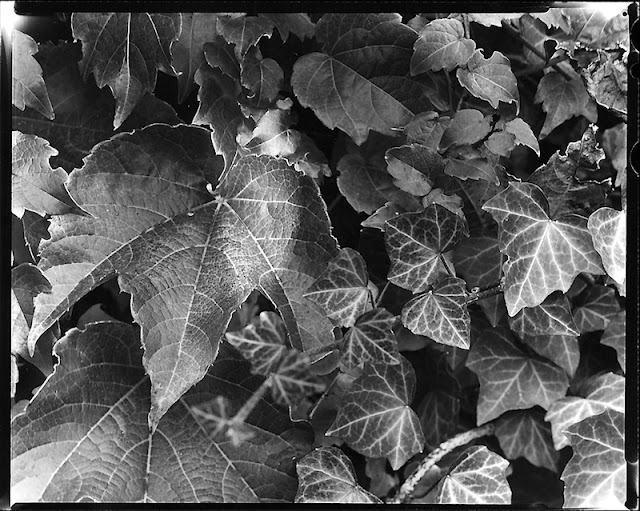
EI 125, f/22, 1/2. 4x5 film using a Calumet CC-401 view camera and Rodenstock Caltar II-e 210mm lens.
I, subjugated. This was shot with a green filter to bring the red leaves in line with the green leaves. By diminishing the levels of the red to match the green, we see everything based on contrast and sharpness, and these guide our eyes through the scene. The crop allows the whole negative to be viewed, although an enlargement would be cropped appropriately.
Here’s hoping you enjoy the rest of your week and capture the shots you’ve been wanting. Get out and make it happen, then show us, share what you felt through your images on our Hohenfels Volks Faceboook page.I'm looking forward to your comments!
Is there anything you’d like to see here? Do you have a question? Share your thoughts here or at the Hohenfels Volks Facebook page. Of course, commenting on both Facebook and here is always appreciated, too! Don't forget, we're on Google+, too!
Firstly, I’d like to thank everyone for continuing to check us out!
I’ve been shooting large format 4x5 film almost exclusively as of late, as well as developing and printing the results. That’s made for some interesting photos and even more interesting discoveries.
Our weather here is typical of Hohenfels, rainy and cloudy. Let’s not forget cold, too! There are still enough leaves and signs of autumn to make for some great photos, so it’s time to get out there and make our visions spring to life. Let’s not forget the Christmas markets that begin at the end of the month, either. Just a trip to the market and you’re presented with more photo possibilities that you can imagine. I’m planning up a couple shots for some friends as I write this. Now’s the time to plan yours, the joyous sights, sounds, and smells will fill your thoughts and if you don’t have at least one planned shot, you’ll be overwhelmed.
Well, I’m going to leave you with this large format photo. It was taken on Ilford’s FP4+ film, developed in Tetenal’s Ultrafin + 1+9, contact printed on Ilford’s MGIV paper, and finally developed in Tetenal’s Eukobrom 1+18 before scanning it as you see it. I adjusted the levels for contrast and mood.
EI 125, f/22, 1/2. 4x5 film using a Calumet CC-401 view camera and Rodenstock Caltar II-e 210mm lens.
I, subjugated. This was shot with a green filter to bring the red leaves in line with the green leaves. By diminishing the levels of the red to match the green, we see everything based on contrast and sharpness, and these guide our eyes through the scene. The crop allows the whole negative to be viewed, although an enlargement would be cropped appropriately.
Here’s hoping you enjoy the rest of your week and capture the shots you’ve been wanting. Get out and make it happen, then show us, share what you felt through your images on our Hohenfels Volks Faceboook page.I'm looking forward to your comments!
Is there anything you’d like to see here? Do you have a question? Share your thoughts here or at the Hohenfels Volks Facebook page. Of course, commenting on both Facebook and here is always appreciated, too! Don't forget, we're on Google+, too!
Subscribe to:
Posts (Atom)